
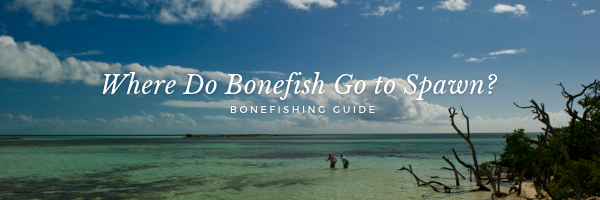
The bonefish you follow across a shallow Grand Bahama flat has a life that extends well beyond casting range. During the reproductive season, adults can leave familiar feeding areas, gather in protected coastal water, and move offshore to spawn.
A bonefish spawning migration connects the flats anglers know with habitats they rarely see. It also gives East End Lodge a particular place in the story: observations by its guides helped researchers investigate a pre-spawning aggregation on Grand Bahama in 2016.
From Home Flats to Gathering Areas
Tagging research summarized by Bonefish & Tarpon Trust has documented bonefish traveling 70 miles or more to reach spawning grounds. Not every bonefish travels that distance.
Before moving offshore, mature fish gather at locations known as pre-spawning aggregation sites. These gatherings can include thousands of fish from a wider area.
The distinction matters. An aggregation site is a staging area, while the final spawning movement takes fish into offshore water. Protecting only the flat where an adult feeds would leave important parts of its reproductive journey exposed.
What Happens Offshore?
Bahamian research has documented aggregations leaving coastal staging areas around dusk and making deep offshore movements. Researchers have tracked dives hundreds of feet below the surface, far deeper than the water where most anglers encounter bonefish.
Bonefish release eggs and sperm into open water. Their larvae subsequently spend weeks in the ocean before settling into suitable juvenile habitat.
Currents can connect distant areas during that larval phase. This helps explain why conservation must consider more than a single island or fishing flat. It does not establish where any individual fish caught beside a skiff originated.
Seasonal Patterns Are Not a Fishing Forecast
Bonefish & Tarpon Trust’s Bahamas conservation plan describes a spawning season from October through April. Research has also associated pre-spawning activity with lunar cycles.
These patterns provide biological context, rather than a promise that fish will gather at a particular place on a particular date. Timing and behavior vary, and a large school alone does not confirm spawning activity.
For a visiting angler, the practical lesson is to avoid treating the moon phase as a complete fishing forecast. Discuss the day’s conditions with your guide and approach each flat according to the water, weather, and fish actually present.
East End Lodge’s Connection to the Research
In late April 2016, East End Lodge guides identified a suspected pre-spawning aggregation and contacted Bonefish & Tarpon Trust. Researchers then visited the site to investigate.
BTT’s contemporary report describes schools of approximately 500 to 3,000 bonefish observed over four days during the full moon phase. It also acknowledges the lodge’s guides and staff for supporting the fieldwork.
That documented contribution shows how time on the water can advance scientific understanding. Guides recognize unusual behavior, while researchers bring methods to investigate it. The value lies in the collaboration and the evidence it produces, rather than assumptions about every large school.
What Anglers Should Do
If your guide suspects a spawning aggregation, leave it undisturbed and fish elsewhere. A concentration of mature fish deserves particular care, and catching fish from it can add stress during an important biological event.
Share unusual observations privately with your guide or a research organization. Avoid publishing precise locations that could draw unnecessary fishing or boat traffic.
On ordinary feeding flats, careful release still matters. Have a photography plan, minimize handling, and remove the hook with the fish in the water where possible. Habitat protection and responsible fishing support different parts of the same life cycle.
A Broader View of Grand Bahama
Spawning research gives another reason to value Grand Bahama’s connected coastal habitats. Feeding flats, travel routes, staging areas, offshore water, and juvenile habitat all contribute to the fishery.
During a stay at East End Lodge, ask your guide how conservation research has changed the way anglers understand these waters. You are unlikely to witness an offshore spawn during a normal fishing day, but you can learn to recognize why the visible flat is only part of the story.
That perspective adds depth to a return: each released bonefish remains part of a journey that reaches beyond the shoreline.